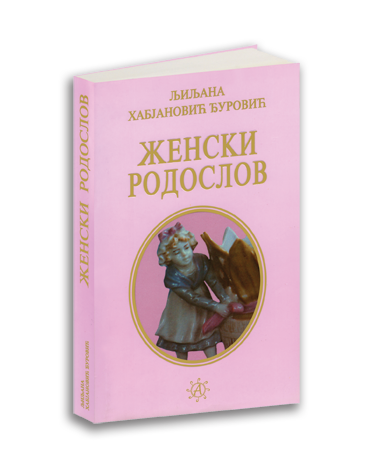
First Edition issued on May 21st 1996. at St. John the Theologian day, 1996.
The 61st legal edition in sale
 |
 |
 |

ABOUT THE BOOK
FEMININE GENEALOGY is an exciting family saga, a bloody anthology of women's sufferings, a dictionary of everlasting women's destiny. Beginning with Ivana, who killed a Turk somewhere in Montenegrin mountains in the early XIX century, and ending with Iva who tries to take control of her own life and to escape from the misfortunes of her female ancestry in the late XX century. Their fascinating destinies remind us of fairy tales: in the period of two hundred of solitude they were born like hares and they died like wolves. They used to seek and to find, to love and to lose. They were poor servants and rich landladies, members revolutionary youth organizations and children of self-managing socialism dressed like hippie girls. Mighty and helpless, devoted and treacherous, they used to have baths in champagne and prepare soups of tears. Succulent and strong prose in which each man will find the woman of his dreams and each woman a part of herself.
Sailors and adventurers, nobles from Kotor and masters from Cetinje, artists and bullies, swindles and royal officers, man from Podgorica and Zagreb, migrant workers and warriors, gamblers and Yugoslav politicians ... were passing throughout their lives and set them.
FEMININE GENEALOGY is a novel about the hunger of the soul, about the need of every human being to choose the goals and find the meaning of life by itself. The story that determines the limits of human strength and courage as well as the price paid by a man who intends to be equal to Gods.
FEMININE GENEALOGY is juicy and strong prose, over which you will think about, which will touch a hidden corners of your soul, prose in which every man shall find a woman that every man dreams of, and every woman shall find at least a part of herself.
PREVIOUS EDITION
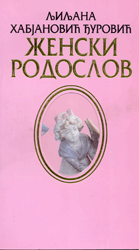 |
NARODNA KNJIGA 1996 |
FOREIGN EDITIONS
 |
 |
 |
 |
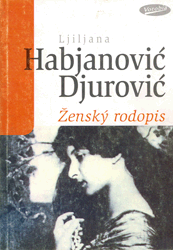
Czech Republic VOTOBIA 1997 |
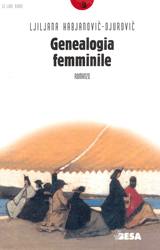
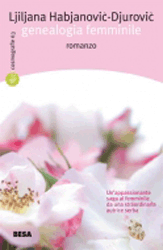
Italy BESA Editrice 2001 |
Italy BESA Editrice 2009 |
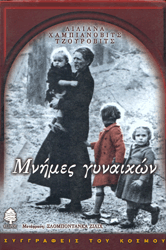
Greece |
 |
 |
 |
 |
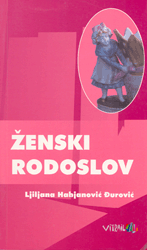
Croatia VBZ 2002 |
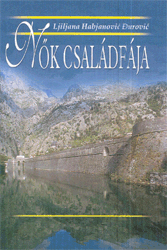
Hungary Muravidek Barati Kor Kulturalis Egyesulet 2007 |
Macedonia NAŠA KULTURA 2010 |
Amazon.com 2014. |
 |
 |
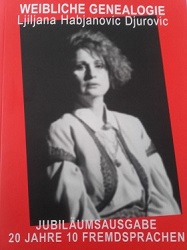 |
|
Bulgaria УНИСКОРП 2015 |
Russia Ид Порог 2015 |
Germany Booy Verlage 2016 |
|
AWARDS AND RECOGNITIONS
Golden bestseller, recognition by Radio Television of Serbia and daily paper Novosti, for one of the ten best-selling books in 1998.
Special golden bestseller for 1998, recognition by Radio Television of Serbia and daily paper Novosti, for the best-selling book of home author for three previous years.
Award of National Library of Serbia, for the most often read book in the libraries of Serbia in 1998.
REVIEWS – ABSTRACTS
This is literaly layered, rich prose. Prooving that she has great skill of a novelist crafts, while doing nothing to please tastes of others or melodramatic sensibility and challenges of opularity, the author wrote a courageous and challenging book.
(Radojka Vukchevic)
The first out of two levers, which are arranged around the episodes of narration, makes the Christian belief that for fathers committed sin the children are to suffer. The sin may cease entirely when it is buy-out with something else, something more valuable, when it turns into a new quality. That wha is stronger and glorious, is love - general one, love towards yourself, neighbors, others... While the author of the book in many places considers what is love, a message pores out through her pen: love is what removes the sin.
(Svenka Savic)
It's hard to say what is best in this novel. Is it a selected theme, language, way of narrative or personal reflection of the author, which forces the reader to conceive over the fundamental values of life and human action. However, it is certain that before us is a very strong, unusual statement.
(Eva Pokorna, "Mlada Fronta DNES", Prague, Szech R.)
QUOTE FROM THE BOOK
Krstinja Milic (Milinic)
Bosiljka Milinic (Sharanovic)
Jelena Sharanovic (Burzan)
Radmila Burzan (Habjanovic)
We are strung like pearls on the thread of our uninterrupted women's genealogy.
Ljiljana Habjanovic (Djurovic)
"It's a terrible thing when a woman's all alone. If husband dies she feels the pain, but at least there's no shame in it. If he leaves her for another woman, she feels the pain and she's been disgraced, too! That means he found someone better, she wasn't any good. But a woman's got no greater misfortune than to lay her own child to eternal rest. I wouldn't wish that on my worst enemy!" said my grandmother Marica.
By this moral and universal judgement, she brought her long and interesting stories to an end. They were true stories, moving, cautionary tales that prepared me for life. They were the most important part of my educative baggage. I took them with me as a trousseau, when I left home, and I have never discarded them. Strung just like the glistening pearls of an exquisite necklace on the silken thread of our never-ending maternal ancestry, they have become a miniature mirror in which I constantly seek the different reflections of my own female essence.
When she died, Grandma Marica had eighty-six years and seemed to know all about pain. Her entire life, in fact, all her experiences, were the lessons of patience and strength, the lessons from the school of pain. The same was the fate of her mother and her daughter, two women irreconcilably different, but of almost identical life drama, in which was inevitably involved a grandmother Marica, although, understandably, in different roles. From her childhood she was observing her aunts and listening about her grandmothers some exciting family legends, like the fairy tales, only without a happy end. (It was her trousseau.) Finally, for years, she devotedly followed all my searchings and uncertainties. In that way she has always supplemented her list of women's misfortunes, bloody anthology of women's pain, the vocabulary of eternal feminine destiny.
Grandmother Marica knew to submit a pain. From whom she learned that so well?
Sometimes it seamed to me that her burden is far to heavy, that she would not be able to stand it or carry it out. I would be afraid that she would stumble, she would fall, but somewhere deep inside of her, she was always finding the strength to stand up and move on, pausing only for a moment, to allocate the burden more evenly.
Looking at her I was often asking myself how long she can go that way. Where is the limit of endurance?
Once I dare to speak up loudly that thought, which troubled me, seams to be banal and pathetic to those unaware in the nobility secret of suffering. I felt that I was entitled to that question and the answer. Because I already had bite an apple of pungent female grief.
Grandmother Marica was sitting with an elbows leaning on the kitchen table, supporting her head by hands shriveled into fists, swinging slowly back and forth, back and forth. She raised her head and stared at me with a straight, long and hard look.
- Where is the limit of endurance? Pray to God to never find out that!
Her voice was trambling. Broken.
These words had just fallen on me. Lead. Stone. Words that were a threat and a warning.
I have not listened to her.